Corporate NDT Training for Teams — 55+ Cities
Book ASNT SNT-TC-1A aligned NDT training for your entire inspection crew. We deliver onsite at your plant or yard, fully online with self-paced online labs, or blended — the theory online and the practical hands-on at your site or ours.
Self-paced online NDT training to ASNT SNT-TC-1A, open to candidates worldwide. Start any time.
Local price for your country, pay with your local card, and course access opens automatically.
Corporate NDT Technician Training Contracts — Built for Inspection Companies
Most corporate engagements fall into two buyer profiles. Asset owners (refineries, EPCs, fabrication yards) train their own maintenance and inspection staff for a specific turnaround or ongoing program. NDT inspection service companies run group NDT training for inspection company staff — building bench strength across a roster of technicians who get deployed to multiple clients, so cohort sizing, method mix, and certification cadence are structured as a standing training contract rather than a one-off course. A typical corporate NDT technician training contract specifies: cohort size (4-25 technicians per batch, scaled to bench strength), the method mix (UT, PAUT, TOFD, RT, MT, PT, ET, VT, MFL, AE, guided wave, thermography, each independently scoped by level), delivery mode (onsite at the inspection company's own facility, online for technicians already deployed across multiple sites, or blended), and a recertification cadence written into the contract term so Level II technicians renew on schedule instead of lapsing mid-assignment.
Methods covered: UT, PAUT, TOFD, RT, MT, PT, ET, VT, MFL, AE, guided wave, thermography. Levels I, II and III, trained and examined by Atlantis to ASNT (CP-189 + SNT-TC-1A). Many crews also hold ISO 9712, PCN, CSWIP or API 510/570/653, each sat separately through its own accredited body — Atlantis tracks those records alongside the ASNT ones it issues. Batch sizes from 4 to 25 technicians. Onsite delivery available in the US Gulf Coast, Middle East, India, UK North Sea, Norway, the Netherlands, Canada, Australia, Singapore, Malaysia and West Africa.
Full enterprise and multi-year framework packages available for asset owners (Aramco, ADNOC, Shell, BP, Chevron, ExxonMobil, QatarEnergy, KOC, PDO, ONGC, Reliance) and for EPC contractors and NDT inspection companies building out their own technician bench. Affordable, accessible, fully customizable — pricing varies by region, batch size and method count; request a tailored quote.
Pick a city for local delivery details, the major NDT employers in the area, typical batch sizes, and city-specific FAQs: Houston, Dubai, Abu Dhabi, Mumbai, Hyderabad, Chennai, Aberdeen, Singapore, Muscat, Jubail, Calgary, London, Rotterdam, Perth.
In more detail
A corporate NDT training contract differs from public course enrollment in almost every dimension — cohort size is set by the client's crew roster rather than open seats, delivery location is negotiated around shutdown and turnaround windows, and the method mix is pulled directly from the client's actual scope of work instead of a fixed public curriculum.
Most inspection companies don't need another open-enrollment UT course seat — they need a defined number of technicians moved from Level I to Level II on a specific method mix, timed so the crew isn't pulled off an active turnaround or offshore rotation all at once. A corporate contract starts with a scope review: current certification mix under the client's written practice, project backlog by method (UT, RT, MT, PT, PAUT, TOFD), and any upcoming shutdown or outage windows that set hard scheduling constraints. From there Atlantis proposes cohort sizing — often 4 to 12 technicians per session depending on equipment availability — and a delivery format: on-site at the client's facility using their own equipment and procedures, or at an Atlantis training location when equipment-neutral instruction is preferable. The result is a training plan mapped to the company's actual staffing gap, not a generic syllabus, with sequencing that keeps enough certified techs on active projects throughout.
Structuring a Corporate Contract Around a Roster, Not a Calendar
Public course enrollment fills seats against a fixed calendar — a set start date, a fixed curriculum, and a set number of open slots anyone can register for. A corporate training contract inverts that. The starting point is the client's own technician roster: how many people need to move up a level, which methods they currently hold certification in under an ASNT SNT-TC-1A-style written practice, and where the gap sits against the work actually being quoted and won. Cohort size follows from that roster rather than from filling a classroom — sessions typically run smaller and more targeted than an open course, because the objective is closing a specific staffing gap, not maximizing enrollment. In practice, cohorts of four to twelve technicians are common, sized to available inspection equipment and to how many people a single instructor can properly evaluate through hands-on practical exams.
Delivery format is negotiated the same way. Some clients want training on-site, using their own NDT methods equipment, calibration blocks, and procedures, so what technicians practice on is identical to what they use on Monday morning. Others prefer an Atlantis facility, particularly when equipment-neutral instruction or a controlled environment matters more than familiarity with house gear. Scheduling is built around the client's shutdown, turnaround, or outage calendar rather than an academic term — training windows get placed in the gaps between active project commitments, not layered on top of them.
Contract length follows the same logic. A single-method Level I to II push for a small cohort might run as a concentrated block over one or two weeks; a multi-method program spanning several certification levels across a larger crew is more often structured as a series of sessions spread over a quarter or more, timed to the client's project calendar rather than delivered as one continuous course.
What a Written Practice Gap Analysis Finds
Before Atlantis proposes a training plan, we look at the client's written practice against their actual backlog by method. It's a common mismatch: a company doing four-fifths of its billable hours in ultrasonic testing but whose written practice and certification mix were built years earlier around a broader, more generic spread of methods. The technicians on staff may be properly certified — the ASNT paperwork can be clean — while the bench still doesn't match what the company is actually selling and staffing today.
That gap shows up operationally as bottlenecks: a UT-heavy backlog competing for two or three UT Level II technicians while RT or MT certifications sit underused elsewhere on the roster. Closing it isn't about adding headcount across the board, it's about re-weighting who trains in what next. A written practice review before a training contract is scoped tells us which certifications to prioritize, which technicians are closest to qualifying for the next level in the method the company actually needs more of, and where cross-training an already-certified tech is faster than training someone from zero.
This matters beyond scheduling. A written practice and certification mix that lags behind actual project mix can affect what an inspection company can credibly bid on. A client bidding UT-heavy turnaround work with a bench weighted toward RT certifications is proposing a staffing story that doesn't match the work. Closing that gap through targeted training strengthens both compliance and the company's ability to win the projects it's actually pursuing.
Sequencing Level Progression and Cross-Training Without Idling the Crew
Moving a workforce from Level I to Level II, or cross-training a certified RT technician into UT or phased array, can't happen as a single event without gutting active project coverage. Corporate contracts are typically sequenced in waves — a portion of the crew trains while the rest stays deployed, then rotates. The order usually follows project risk: technicians closest to their next certification and working on lower-priority jobs go first; techs carrying critical coverage on an active turnaround or outage go last, or train in shorter modules stretched across the outage's downtime. This is particularly relevant for crews supporting turnaround-heavy clients, where pulling more than a fraction of certified staff off the floor during a live outage isn't operationally possible regardless of how badly a certification gap needs closing.
Cross-training an RT technician into UT or PAUT is a different sequencing problem than a straight Level I-to-II progression — it means teaching a new inspection method against existing radiographic interpretation experience rather than building from zero, which changes both the hours required and where the training fits into the technician's active workload. A well-sequenced multi-method plan accounts for this explicitly instead of applying one training cadence to every technician regardless of their starting point.
Tracking who has completed which module, and against which procedure revision, matters as much as the training itself once a cohort is split into waves — a partially trained crew moving between assignments needs a clear record of exactly what each technician has completed, particularly when recertification timelines are running in parallel with the new-method training.
What to Put in an RFP to Get Comparable Vendor Quotes
Corporate training RFPs that leave out scope details tend to get quotes that can't actually be compared against each other. At minimum, a scope should specify: the number of technicians by current certification level, the target methods and levels for each cohort, whether delivery is on-site or at a training facility, and the scheduling windows available around turnarounds or outages. Vendors size crews, equipment, and instructor time very differently once those variables are fixed — for context on the breadth of methods and levels Atlantis covers outside corporate contracts, see training. A scope that also states the expected practical exam format helps vendors size instructor time realistically rather than guessing at how rigorous the assessment needs to be.
It's also worth specifying whether written practice alignment is in scope. Some vendors will train against whatever curriculum the client names without checking it against the company's actual Level III-reviewed written practice or project mix, which can produce technicians certified in the wrong things for the work being sold. A tighter RFP asks the vendor to review the written practice as part of scoping, not just deliver a fixed course.
Finally, ask what the instructor's own certification and field experience is in the specific method being taught, not just their instructor credential — a Level III with hands-on field time in phased array teaches PAUT differently than one whose recent experience is mostly classroom-based. This is easy to specify in an RFP and easy for vendors to answer directly, which makes it a good discriminator between otherwise similar-looking quotes.
How many technicians does a corporate training cohort usually include?
Cohort size is set by the client's roster and equipment availability rather than a fixed class size — most corporate sessions run smaller than an open-enrollment course because the goal is closing a specific staffing gap, not filling seats.
Can training happen on our own equipment and procedures?
Yes. On-site delivery using the client's own equipment, calibration blocks, and written procedures is one of the two standard delivery formats, alongside training at an Atlantis facility when equipment-neutral instruction is preferred.
How is training scheduled around an active turnaround or outage?
Training windows are built around the client's shutdown, turnaround, or outage calendar rather than an academic term, so sessions land in the gaps between project commitments instead of competing with active crew coverage.
Does Atlantis review our written practice before proposing a training plan?
Yes — a scope review of the client's written practice against their actual project backlog by method is standard groundwork before cohort sizing and method mix are proposed.
What if our crew needs multiple methods, not just one?
Multi-method sequencing is common — technicians are grouped by how close they are to their next certification and by project risk, so cross-training in a second or third method happens in waves rather than pulling the whole crew off active work at once.
What should we include in an RFP for a corporate training contract?
Specify current certification levels by technician, target methods and levels, on-site versus facility delivery, available scheduling windows, and whether written practice alignment is part of the scope — this lets vendors quote against the same engagement instead of different assumptions.
Do technicians keep working while the rest of the crew trains?
Yes — sequencing is built around that constraint specifically. Cohorts are split into waves so a portion of the crew is always available for active project coverage, with training scheduled against the client's turnaround and outage calendar rather than pulled from it.
How far in advance should a corporate training contract be scoped before the target start date?
Enough lead time to align with equipment availability and instructor scheduling matters more than a fixed number — but building the scope around an upcoming turnaround or outage window, rather than an arbitrary calendar date, is what actually determines how much lead time is needed.
Nationwide: NDT training by city, state and region
Every programme below is delivered online or onsite at the employer's facility under ASNT Level III oversight. Atlantis does not run walk-in training centres. Pick your market for local industries, codes and employer requirements.
United States — cities
- NDT training in Aiken, SC
- NDT training in Albuquerque, NM
- NDT training in Anchorage, AK
- NDT training in Atlanta, GA
- NDT training in Austin, TX
- NDT training in Baltimore, MD
- NDT training in Bath, ME
- NDT training in Baton Rouge, LA
- NDT training in Baytown, TX
- NDT training in Beaumont, TX
- NDT training in Billings, MT
- NDT training in Boston, MA
- NDT training in Buffalo, NY
- NDT training in Charlotte, NC
- NDT training in Chicago, IL
- NDT training in Cincinnati, OH
- NDT training in Cleveland, OH
- NDT training in Columbus, OH
- NDT training in Corpus Christi, TX
- NDT training in Dallas, TX
- NDT training in Deer Park, TX
- NDT training in Denver, CO
- NDT training in Des Moines, IA
- NDT training in Detroit, MI
- NDT training in Duluth, MN
- NDT training in East Hartford, CT
- NDT training in El Paso, TX
- NDT training in El Segundo, CA
- NDT training in Fayetteville, NC
- NDT training in Fort Worth, TX
- NDT training in Galveston, TX
- NDT training in Groton, CT
- NDT training in Honolulu, HI
- NDT training in Houston, TX
- NDT training in Huntsville, AL
- NDT training in Idaho Falls, ID
- NDT training in Indianapolis, IN
- NDT training in Jackson, MS
- NDT training in Jacksonville, FL
- NDT training in Kansas City, MO
- NDT training in Lake Charles, LA
- NDT training in Las Vegas, NV
- NDT training in Lexington, KY
- NDT training in Little Rock, AR
- NDT training in Los Angeles, CA
- NDT training in Martinez, CA
- NDT training in Miami, FL
- NDT training in Midland, TX
- NDT training in Milwaukee, WI
- NDT training in Minneapolis, MN
- NDT training in Mobile, AL
- NDT training in Montgomery, AL
- NDT training in Nashville, TN
- NDT training in New Orleans, LA
- NDT training in New York, NY
- NDT training in Newark, NJ
- NDT training in Newport News, VA
- NDT training in Norfolk, VA
- NDT training in North Charleston, SC
- NDT training in Oak Ridge, TN
- NDT training in Odessa, TX
- NDT training in Oklahoma City, OK
- NDT training in Omaha, NE
- NDT training in Orlando, FL
- NDT training in Pasadena, TX
- NDT training in Pascagoula, MS
- NDT training in Philadelphia, PA
- NDT training in Phoenix, AZ
- NDT training in Pittsburgh, PA
- NDT training in Port Arthur, TX
- NDT training in Portland, OR
- NDT training in Providence, RI
- NDT training in Richland, WA
- NDT training in Salt Lake City, UT
- NDT training in San Antonio, TX
- NDT training in San Diego, CA
- NDT training in San Francisco, CA
- NDT training in San Jose, CA
- NDT training in Savannah, GA
- NDT training in Seattle, WA
- NDT training in Springfield, IL
- NDT training in St. Louis, MO
- NDT training in Sugar Land, TX
- NDT training in Tampa, FL
- NDT training in Texas City, TX
- NDT training in Tulsa, OK
- NDT training in Washington, DC
- NDT training in Whiting, IN
- NDT training in Wichita, KS
- NDT training in Williston, ND
United States — states and regions
- NDT training in Alabama
- NDT training in Alaska
- NDT training in Appalachia
- NDT training in Arizona
- NDT training in Arkansas
- NDT training in California
- NDT training in Colorado
- NDT training in Connecticut
- NDT training in Delaware
- NDT training in Florida
- NDT training in Georgia
- NDT training in Hawaii
- NDT training in Idaho
- NDT training in Illinois
- NDT training in Indiana
- NDT training in Inland Texas
- NDT training in Iowa
- NDT training in Kansas
- NDT training in Kentucky
- NDT training in Louisiana
- NDT training in Maine
- NDT training in Maryland
- NDT training in Massachusetts
- NDT training in Michigan
- NDT training in Minnesota
- NDT training in Mississippi
- NDT training in Missouri
- NDT training in Montana
- NDT training in Nebraska
- NDT training in Nevada
- NDT training in New Hampshire
- NDT training in New Jersey
- NDT training in New Mexico
- NDT training in North Carolina
- NDT training in North Dakota
- NDT training in Ohio
- NDT training in Oklahoma
- NDT training in Oregon
- NDT training in Pennsylvania
- NDT training in Rhode Island
- NDT training in South Carolina
- NDT training in South Dakota
- NDT training in Southern California
- NDT training in Tennessee
- NDT training in Texas
- NDT training in the Great Lakes
- NDT training in the Gulf Coast
- NDT training in the Mid-Atlantic
- NDT training in the Midwest
- NDT training in the Northeast
- NDT training in the Pacific Northwest
- NDT training in the Permian Basin
- NDT training in the Rockies & Plains
- NDT training in the Southeast
- NDT training in the West Coast
- NDT training in Utah
- NDT training in Vermont
- NDT training in Virginia
- NDT training in Washington
- NDT training in West Virginia
- NDT training in Wisconsin
- NDT training in Wyoming
Canada
- NDT training in Alberta
- NDT training in British Columbia
- NDT training in Calgary, AB
- NDT training in Canada
- NDT training in Edmonton, AB
- NDT training in Fort McMurray, AB
- NDT training in Halifax, NS
- NDT training in Manitoba
- NDT training in Montreal, QC
- NDT training in New Brunswick
- NDT training in Newfoundland and Labrador
- NDT training in Nova Scotia
- NDT training in Ontario
- NDT training in Quebec
- NDT training in Saint John, NB
- NDT training in Sarnia, ON
- NDT training in Saskatchewan
- NDT training in Vancouver, BC
- NDT training in Winnipeg, MB
Certifying a whole crew? See the SNT-TC-1A certification programme for NDT companies.
The LMS and Practical NDT together
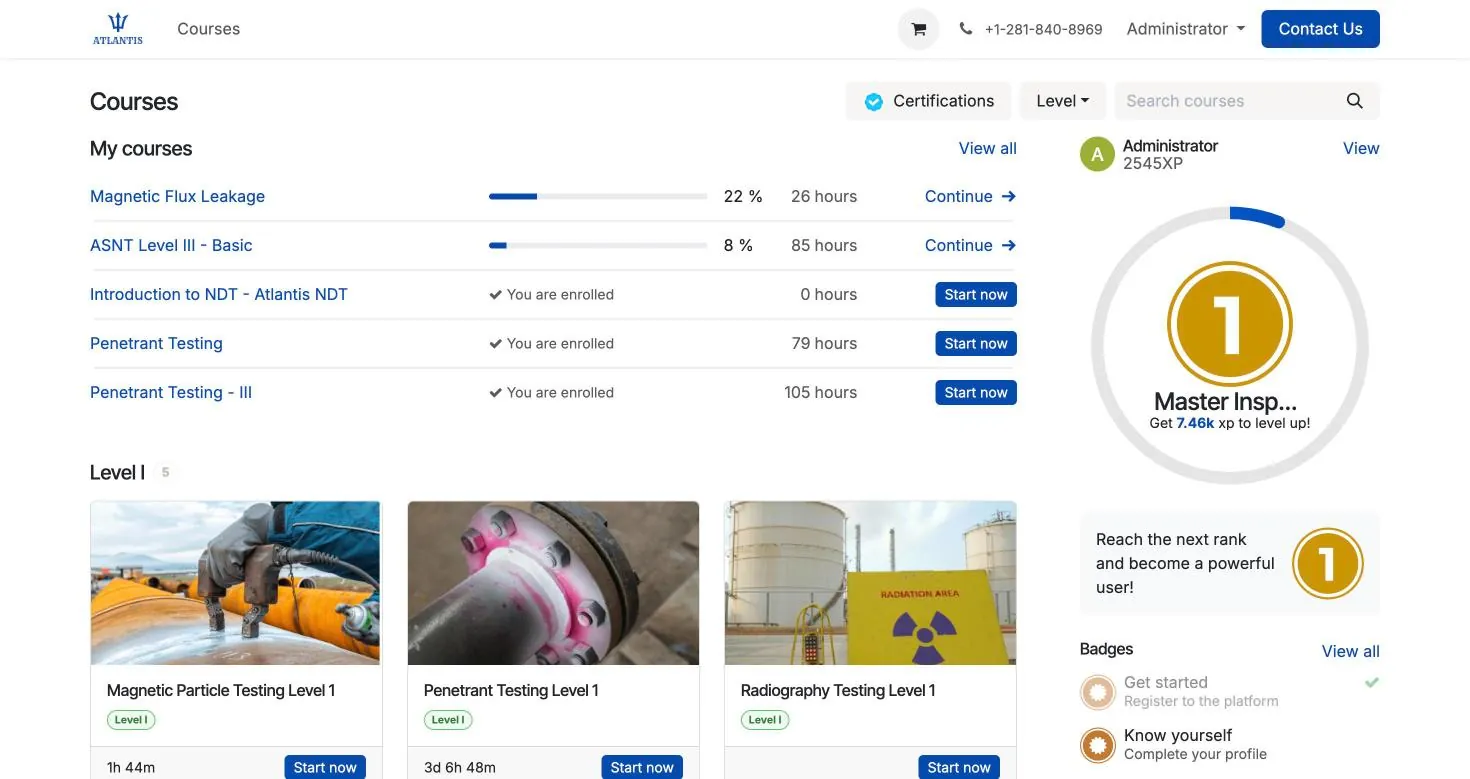
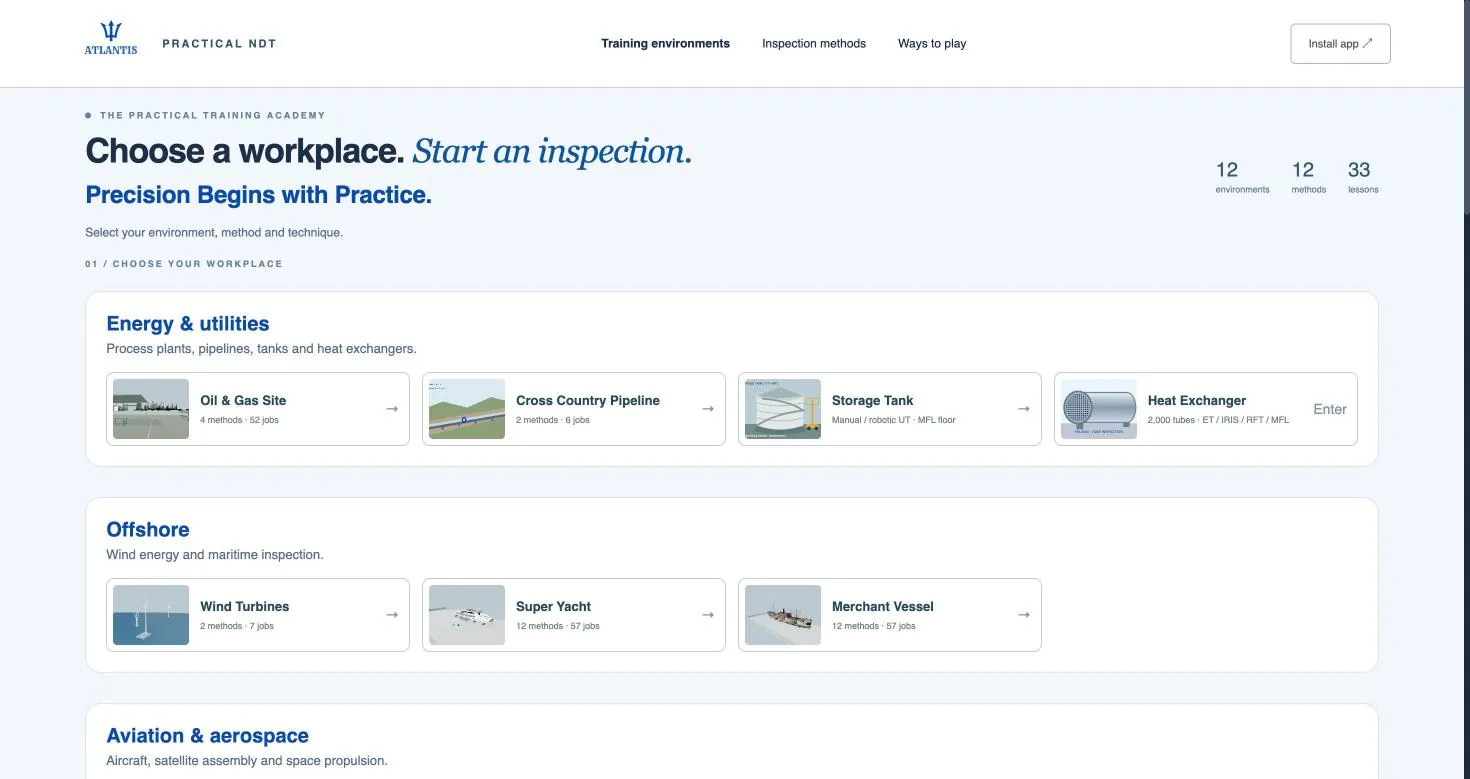
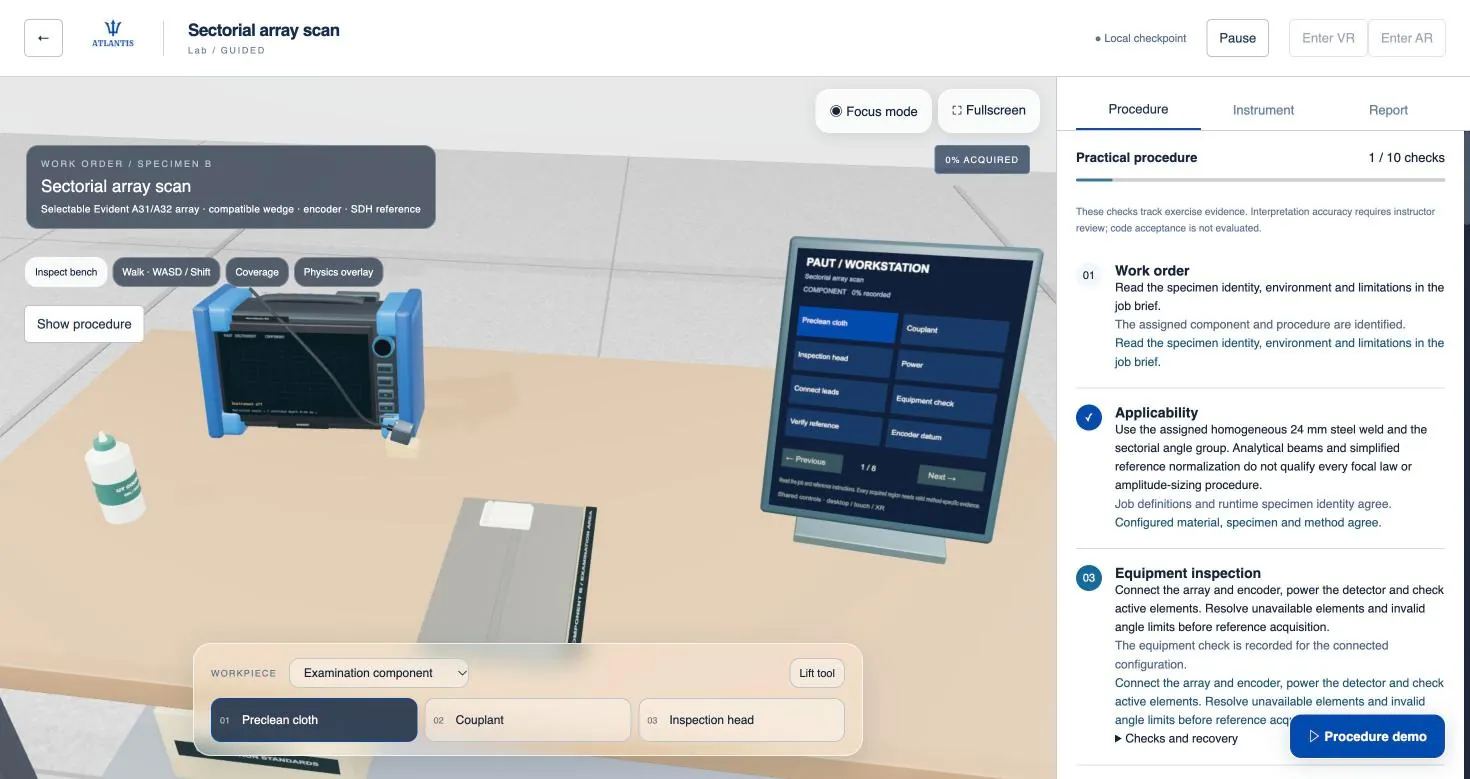
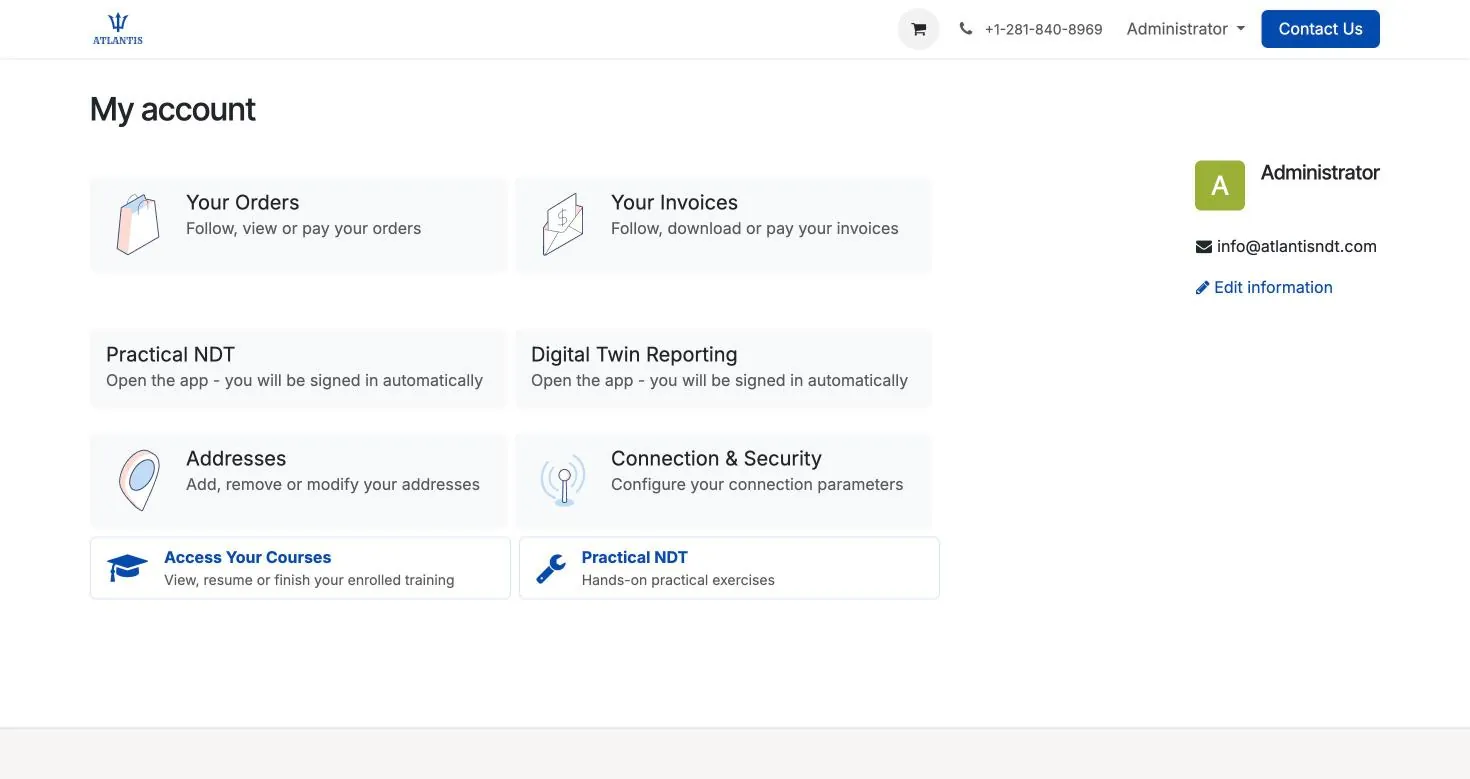
Practical NDT is integrated with the Atlantis LMS and ERP, so learners move from a course into the simulator. Screenshots of both as they run today.
Practise between sessions
Free practice tests and downloadable question packs show where you stand, and Practical NDT lets you practise scans on a 3D simulator before the practical examination.
On-site NDT training for a crew
On-site NDT training brings the course to your plant, yard or shop, using your own parts and procedures where possible, so the crew trains on the work they will actually do.
- When on-site beats a public course. Several technicians need the same method, travel would take people off jobs, or your parts and procedures are specific to your work.
- Blended option. Theory online with a Level III, then the practical on site.
- Training completion versus certification. Completing a course gives you a training record and hours. Certification is a separate step: under SNT-TC-1A or CP-189 your employer certifies you against its written practice. ASNT certifies individuals directly through ASNT NDT Level II and Level III; for ASNT NDT Level II the employer still carries out the vision, practical and any job-specific exams.
What do you need from us for on-site NDT training?
A room, the equipment the crew will use or ours, representative parts or specimens, and your written practice so the hours are recorded against it.
Speak to an ASNT NDT Level III
Discuss your inspection requirements with Atlantis NDT. Include the asset, method, location and documents you need reviewed.
Corporate NDT training qualifies a whole crew at once, on your equipment, against your written practice. Under ASNT SNT-TC-1A the employer certifies the technician — the trainer never does — so the deliverable is a personnel file per person: training hours, documented OJT, general, specific and practical examination scores, vision test, and the Level III signature.
An employer-sponsored cohort exists because certification in the United States is an employer act, not a school act. SNT-TC-1A is a recommended practice; what binds is the written practice the employer signs, and the certificate carries the employer's name. Training a crew against that document — on the shop's own equipment, its own procedures, and specimens cut from its own product — closes the gap that opens when technicians are sent to public courses one at a time and return certified against somebody else's procedure. The commercial arithmetic follows: no travel and per diem for six to twenty people, no rota gaps while technicians are away, one examination cycle instead of a dozen, and one set of records in one format an auditor can read end to end. Atlantis runs cohorts on-site under ASNT Level III oversight and does not operate walk-in classrooms. Quote on request.
Source: ASNT SNT-TC-1A (2020 edition) — written practice, training, examination, certification and records; ANSI/ASNT CP-189 where a national standard is contractually required; ISO 9712:2021 for third-party certification.
| Cohort type | Who is in it | SNT-TC-1A classroom hours | Documented OJT in the method | What the employer files afterwards |
|---|---|---|---|---|
| New-hire Level I, surface methods | Hires with no NDT background, going onto MT and PT work | MT 12, PT 4 | MT 70, PT 70 | Training record, three examination scores per method, vision test, Level III signature |
| New-hire Level I, volumetric methods | Hires going onto UT or RT | 40 per method | 210 per method | Same file, plus the specimen set used in the practical examination |
| Level I to Level II upgrade | Certified Level I technicians with hours already logged | 40 for UT or RT, 8 for MT or PT | 630 additional for UT or RT; 210 additional for MT | Upgrade certificate, cumulative OJT log, practical run on production specimens |
| Cross-method add-on | Existing Level II adding a second method | From 4 hours (PT Level I) to 40 hours (UT Level I) | From 70 hours to 210 hours, by method | One file per person per method — never one file per person |
| Recertification cycle | Anyone approaching the five-year mark | Refresher as set by the written practice | Continuous documented activity in the method | Re-examination or documented performance, fresh vision test, new expiry date |
| Level III programme authority | The person who signs everything above | Per the SNT-TC-1A education and experience route | Per method held | Level III credentials, approved procedures, annual programme review record |
Who certifies the technician — the training provider or the employer?
The employer. ASNT SNT-TC-1A places certification with the employer, issued against the employer's own written practice and signed by a Level III. A training provider delivers the classroom hours, builds and administers the examinations, and supplies Level III oversight, but the certificate carries the employer's name. That is exactly why a cohort trained on your own procedures is the cleaner route.
What does an employer need in place before an on-site cohort starts?
A written practice, or a Level III engaged to write one; approved procedures for each method and technique; calibrated equipment the crew will use in production; specimens containing known discontinuities cut from your own product; a room that holds the classroom sessions; and a current vision test for every candidate. The specimens are the item most often missing on day one.
How many technicians make a workable on-site cohort?
Four to twenty-five per batch. Below four, the fixed cost of mobilising an instructor and a full examination set is spread too thin. Above twenty-five, the practical stations queue and hands-on time per technician collapses — and hands-on time is what produces a defensible practical examination. Larger crews run as sequential batches on a single mobilisation.
Do cohort certifications survive a client audit?
They survive when the file does. An auditor checks the written practice against SNT-TC-1A or ANSI/ASNT CP-189, then samples technicians for training hours, documented OJT, three examination scores, a current vision test, the Level III signature, and an unexpired certification date. A cohort produces all of that in one format on one date, so sampling closes faster than with piecemeal certifications.
If a technician leaves, does the certification go with them?
No. Employer-based certification ends with the employment. What the technician keeps is the record — training hours, documented on-the-job hours and examination history — which the next employer's Level III can credit before examining and certifying afresh. For the employer, that argues for complete records and for building bench depth rather than single points of failure on a method.
SNT-TC-1A or ISO 9712 — which does a US crew need?
SNT-TC-1A for US work. It is the employer-based route that American clients, AWS D1.1 fabrication and ASME pressure work expect. ISO 9712:2021 is third-party certification issued by an accredited body, valid five years and renewable for a further five. European, Middle East and marine clients ask for it. Crews working both markets carry both, which one cohort programme can sequence.
Ask about NDT training and practical arrangements
Tell us the methods and levels you need, how many technicians and where they work. We reply within one business day with the delivery options that fit, how the practical at your facility would work, and what your written practice requires.
Request a quote / enrol · Employer-sponsored training · info@atlantisndt.com